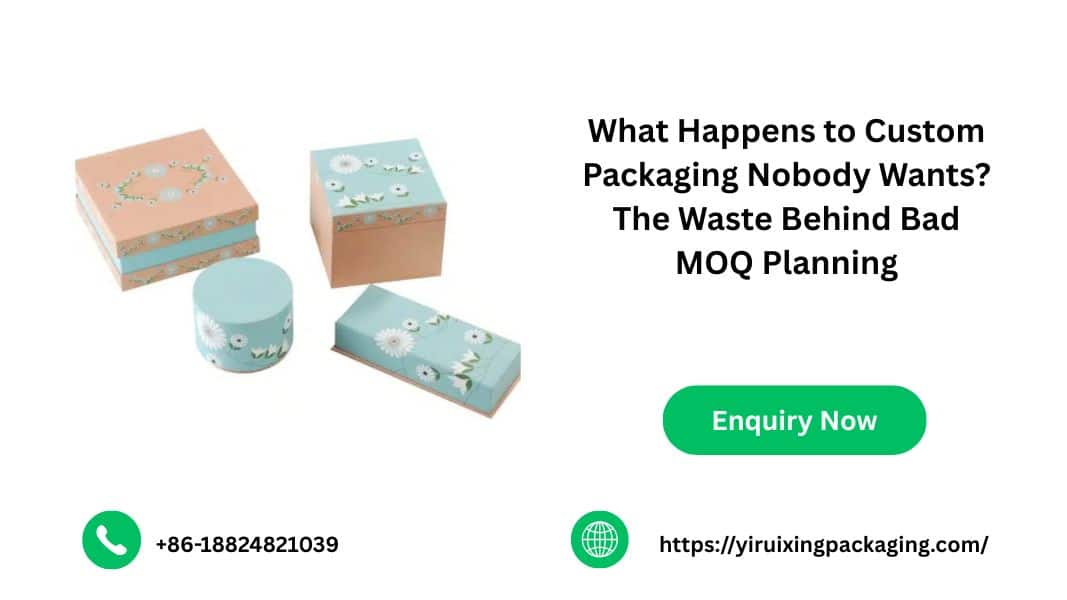
What Happens to Custom Packaging Nobody Wants? The Waste Behind Bad MOQ Planning – Custom packaging helps products appear premium, improves brand recognition, and gives an amazing unboxing experience to customers. However, What Happens to Custom Packaging Nobody Wants and how can it be managed when the order is way bigger than needed by a company?
The result may be embarrassing – unwanted custom packaging becomes expensive excess stock or waste.
And that is the reason why MOQ (Minimum Order Quantity) planning should be taken into consideration. In many cases, MOQ from a supplier will make manufacturing efficient due to reduced setup and tooling costs. However, the lowest cost per box is not always the lowest cost for a business.
Why Does Custom Packaging Become Waste?
Let us suppose you have launched a new product and ordered 20000 custom printed boxes because the supplier offers a competitive bulk price. Half a year later, the sales were lower than anticipated. Or maybe there were some other changes – the product became bigger, your logo was updated, a statement had to be added according to regulations, or the product became completely out-of-date completely.
All of a sudden, those 20000 boxes turned from assets into obsolete packaging inventory.
Unlike generic packaging, custom packaging cannot easily be reused. A generic brown box can be used for another product. Custom boxes featuring product names, product ingredients, sizes, barcodes, or campaign messages are less versatile.
This results in three types of waste:
- Waste from material use: Paper, cardboard, plastic films, ink, glue, and other raw materials have already been used.
- Waste from money: Money is invested in packaging that will most likely never turn out to be profitable.
- Waste from logistics: Unutilized cartons take space in storage and add costs associated with handling and management.
The production of packaging itself can create setup waste. Printing and converting machines require setup prior to production, which means that setup waste takes up a bigger percentage of total cost on shorter production runs.
Hidden Problem of High MOQ
High MOQ is not necessarily a bad thing. In fact, high MOQ allows reducing the cost of each item since setup costs are divided between more items.
The issue arises when MOQ becomes an objective, not a production reality.
Just because your supplier says MOQ is 5000 pieces doesn’t mean you must order 5000 right away. The correct amount you need is determined by your sales forecast, product life cycle, cash flow, warehouse space, SKU complexity, and likelihood of your packaging specifications changing.
| MOQ Planning Factor | What to Ask | Risk If Ignored |
| Sales forecast | How many units will realistically sell? | Overstock |
| Product life cycle | How long will this design remain current? | Obsolete packaging |
| SKU count | Is the MOQ applied per design or SKU? | Unexpected inventory |
| Storage | Where will unused packaging go? | Higher warehouse costs |
| Cash flow | Can the business comfortably fund the entire run? | Capital tied up |
| Reorder timing | How quickly can the supplier produce another batch? | Stockouts or rush orders |
And for brands with several products, the challenge gets bigger. It turns a seemingly manageable overall quantity ordered into several different packaging MOQs depending on sizes, design, language, material, or finish.
How Poor MOQ Planning Results in Wasted Packaging
Poor MOQ planning usually starts with the following simple formula:
“The more we order, the cheaper the unit price.”
This formula is inaccurate.
Assume that 10000 boxes have a cheaper unit price than 2000 boxes. And if your company only needs 3000 boxes before the redesign, the savings become obvious. You just paid for many thousands of boxes that you could not use.
A better formula accounts for total packaging costs that include:
Unit cost + tooling + freight + storage + inventory holding cost + potential obsolete cost = total packaging cost
It takes focus off unit price and makes it more about total cost of ownership.
How to Avoid Unnecessary Custom Packaging
Avoiding custom packaging might be the worst thing you can do. The ideal approach is to ensure that your packaging ordering is consistent with your actual demand for the product.
1. Forecast Demand Before Purchase
Based on past sales, future projections, seasonal needs, and marketing activities, forecast the use of your packaging. At the end of the day, the need for packaging is always associated with the volume of your products.
2. Know the MOQ Per SKU
Inquire from your packaging vendor what kind of minimum order quantity policy applies – whether to the entire order, per design, per size, or per manufacturing setup. Not all structures and designs need separate manufacturing setups.
3. Opt for Flexible Packaging Solution
When introducing a new product, try to combine standard packaging structures with custom labeling, printing, or inserts. This way, you can save your brand name while minimizing risks of getting stuck with too much outdated packaging.
4. Factor in Flexibility
Remember that packaging art is not set in stone. The product claims, ingredients, barcodes, sizes, brand image, and market requirements can be revised. Design your inventory strategy in a way to incorporate this fact.
5. Talk to Your Supplier About MOQ Early On
The manufacturer of your packaging can provide recommendations regarding alternative materials, printing techniques, standard sizes, co-production, and partial orders. Low MOQ packaging can often be ordered via digital printing or standardized structures, depending on the specifics of the project.
The Sustainable Aspect of MOQ Management
Sustainability doesn’t mean recycling or biodegradability of packaging alone. It means not producing any packaging at all when there’s no need for it.
The box that looks great and can be recycled is still a waste of energy and resources if it never leaves the warehouse due to a change in the product’s claims.
Therefore, sustainable packaging needs to be planned considering its full life cycle.
Improved demand forecasting and MOQ planning will thus help achieve both cost savings and sustainable packaging.
Conclusion
The real cost of custom packaging isn’t just how much you pay for each box. What Happens to Custom Packaging Nobody Wants? The Waste Behind Bad MOQ Planning, after all, is an issue of forecasting, flexibility, and responsible procurement.
Brands in need of a reliable custom packaging manufacturer, custom packaging boxes, printed packaging, and flexible MOQ options can find them at Yiruixing Packaging, helping to make packaging needs into reality. All that is required is packaging that works for your brand and not the other way around.
FAQs
What happens to custom packaging nobody wants?
Unwanted custom packaging may end up being dead stock, taking up space in warehouses, or being recycled or thrown away in the end. In the case of packaging carrying product-specific information, its reuse may not always be possible.
Does a bigger MOQ mean lower costs?
Not necessarily. A larger MOQ may lower the cost per unit but raise total expenses if the packaging doesn’t get used. An optimal MOQ strikes a balance between the unit cost and demand, storage, cash flow, and risks associated with changing the product.
How do I lower the MOQ for packaging?
Inquire about standard construction, digital printing, simpler finishing, shared tooling, different materials, or staggered manufacturing. Which methods would work will depend on the packaging and producer.
Can startups order bulk custom packaging?
Startups need to take extra care when working with large MOQs because demand is less certain in this case. Ordering a smaller production volume or selecting more flexible packaging solutions is one way to avoid having obsolete stock.
Which factor should weigh most in the selection of packaging MOQ?
The main criterion should be the projected packaging consumption throughout the lifetime of the packaging design. Compare your estimates to the MOQ and consider how soon you’ll be able to place an additional order.