Choosing a suitable package requires more than picking up the most colorful one that looks appealing. The package has to provide protection for the product, represent the identity of your company, and perform efficiently when transported, stored, and used. This is why How to Evaluate a Custom Packaging Sample before the start of mass production is necessary for any buyer.
By means of a sample, you will have an opportunity to notice design flaws, inconsistencies in materials, printing issues, and other drawbacks before it’s too late and you incur extra expenses. By means of a buyer’s practical scorecard, you will be able to assess three main factors: fit, finish, and function. Here is how to make every packaging sample assessment efficient.
Why is Evaluating a Custom Packaging Sample So Important?
A computer-generated sample may seem perfect, but in reality, there can be a lot of flaws that will only become apparent when the real product is delivered. Colors can be too dull, dimensions can be wrong, materials can be too fragile, and closures can be malfunctioning.
Evaluation of a custom packaging sample will help you to:
- Ensure compatibility and correct dimensions of the product.
- Evaluate the quality and durability of materials used.
- Check printing accuracy and coloring.
- Test the packing assembly, opening, closing, and shipping.
- Minimize delays in production, waste, and unforeseen costs.
The key to the game – making sure the approved sample represents the level of packaging quality expected for the order.
Buyer’s Scorecard: Fit, Finish, and Function
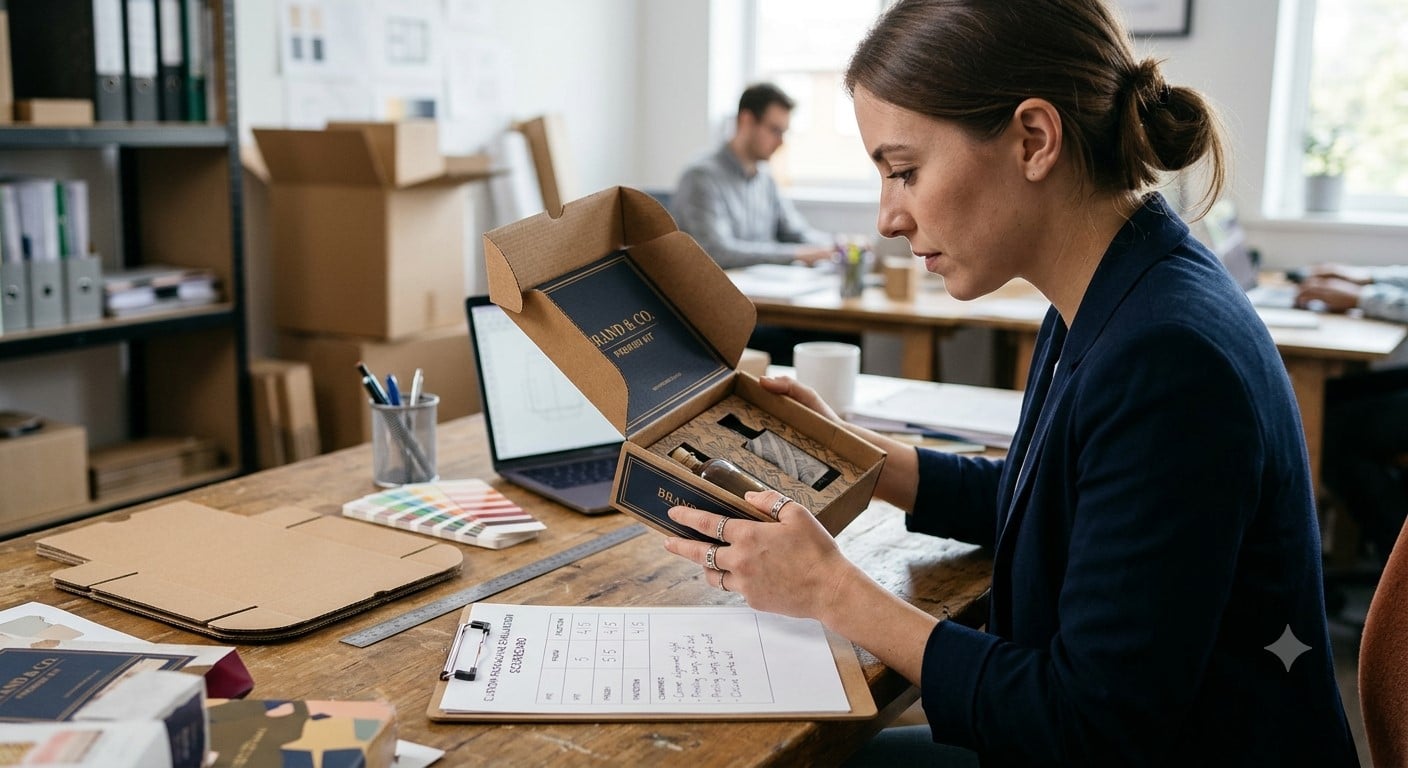
Below is the scorecard that will help you evaluate your sample objectively. Give each criterion a mark from 1 to 5, where 1 means poor and 5 means excellent.
| Evaluation Criteria | Criteria | Score |
| Fit | Dimensions, clearance, inserts, alignment | /5 |
| Finish | Printing, colors, surface finish, edges | /5 |
| Function | Closure, assembly, protection, ease of use | /5 |
| Material Quality | Thickness, stiffness, durability | /5 |
| Branding | Positioning of logo, clarity, accuracy | /5 |
| Shipping Readiness | Packing, handling, protection during transportation | /5 |
Max score: 30 points. In general, as an internal benchmark, 26-30 points mean the package is ready for final approval, 21-25 can be revised, and 20 or less require further analysis. These are just suggested criteria and do not represent any industry standard. All the safety, fit, and protection issues prevent approval of the package, whatever the total score is.
1. Fit: Does the Packaging Fit Your Product?
The first thing to check when evaluating a custom packaging prototype is the packaging’s size and the compatibility with the product.
Put the actual product in the prototype. Is there enough room? Is the product secure and easy to take out of the package? Is there enough room for protective inserts, tissue, cushioning, or other elements?
Pay attention to the following:
- Dimensions: measure the inner length, width, and height.
- Product protection: watch out for unwanted movement of the product and contact points.
- Inserts: Do the inserts, trays, and cushioning fit well?
- Assembly: Do all the panels, folds, and tabs assemble perfectly?
Even a tiny mistake in the dimensions can become significant when producing thousands of units. Always test using the actual product instead of just measuring the prototype based on drawings.
2. Finish: Is Your Packaging Up To Your Standards?
Finish is one of the things that will affect how the packaging looks and feels to customers. It defines the overall quality of the packaging, particularly for premium retail, consumer, and gift products.
When conducting your packaging quality inspection, conduct the test under both natural and indoor lighting, and check if the printed colors compare favorably with your brand-approved samples. Also, ensure that the text, logo, and graphics are clear and properly placed.
Take note of:
- Print quality: Check for smears, blurred print, and poor ink distribution.
- Color accuracy: Compare the packaging against approved color specifications.
- Finishes: Check matte, glossy, textural, and lamination finishes.
- Construction: Check for rough edges, peeled parts, and glue marks.
If your packaging incorporates features such as embossing, foiling, spot UV, among others, make sure that they are well executed.
Do not forget that even beautifully designed packaging is of no value if the supplier does not have the capability to produce quality in large volumes.
3. Function: Is the Packaging Functional?
For the packaging to be successful, it must perform its tasks outside of the showroom. It must protect the product, be easy to use, and deliver customer convenience.
Repeat the test of the closure multiple times. Test whether the box opens and closes, whether any inserts assemble correctly, and whether any flaps, magnetic closures, adhesive strips, or locking mechanisms work properly.
Then, evaluate how the packaging will behave during transportation. See whether it can be stacked easily, whether it stands up to normal handling, and whether it offers enough protection from the shipping conditions expected.
For fragile products, heavy products, moisture-sensitive products, or long-distance shipments, perform protective packaging tests. These will likely involve compression tests, vibration tests, or drop tests.
Remember: just because a prototype looks tough does not mean that it meets shipping requirements.
4. Evaluate Packaging Materials, Sustainability, and Manufacturing Consistency
In addition to the fit and finish of the packaging, evaluate the actual material against your specs. Check to see how thick, rigid, textured, and heavy it actually is.
If sustainability is important to your brand, verify the claims about sustainability rather than accepting looks alone. Request documentation about the materials used and any certifications received.
Also, ensure that the sample utilizes the correct materials, printing, finish, and construction. If a prototype is created using substitute materials, it may not be an accurate representation of the final production item.
5. Record Your Feedback Before Approving Bulk Production
The scorecard is more effective if it is followed up by taking action. Take photos of any defects, measure everything, and write down all changes required.
Pass your feedback on to the packaging manufacturer and ask for a new sample where necessary. When your requirements have been satisfied, document the specifications that have been approved and keep a copy of the sample on file.
This is a very easy process that ensures there will be no doubt about what “approved” means in the future.
Conclusion
Careful evaluation of a packaging sample will enable you to protect your products, maintain brand consistency, and make informed purchasing decisions. Use your scorecard, test in the real world, and only approve bulk production when the sample meets your requirements.
Looking for a packaging partner for your next project? Yiruixing Packaging offers customized packaging solutions, including rigid boxes, corrugated packaging, gift boxes, and flexible pouches. Explore its product range to find options suited to your product, branding, and packaging requirements. Contact the team to discuss your specifications and request a tailored quote.
FAQs
What should I check to determine whether a custom packaging sample is good or not?
Consider dimensions, the ability of the package to fit your product inside, the quality of material used, printing, finish, closing, and protection. You should examine the physical sample according to your specifications and try it with the product itself.
How to understand whether the packaging sample is ready for production?
It is ready when it corresponds to your dimensional, visual, material, and other requirements. Verify that all requested corrections have been made, specify the final parameters of the packaging, and set control measures for bulk production.
Why should I test my packaging samples before ordering bulk production?
Testing allows you to identify defects in design, poor quality of materials, wrong printing, and other problems before they occur on the entire batch. It helps eliminate unnecessary rework, production waste, shipping damage, and needless expense.
How does a packaging prototype differ from a production sample?
The former is used when testing a design or concept, while the latter is used to check how the materials, printing, finishes, and construction will look on the final order. It is always important that you know the difference between these two samples before giving the production go-ahead signal.
Can a packaging sample be a beautiful piece but still not pass inspection?
Yes, since it could have good printing and finishing but might fail due to improper dimensions, faulty closures, insufficient cushioning, and inadequate shipping protection. That is why fit, finish, and function should all be considered.