Custom Packaging Sample vs. Prototype: What Is the Difference? – When creating a new package, expressions such as custom packaging sample, packaging prototype, mockup, and pre-production sample can be used to describe the same item. But they have different applications within the process of packaging creation.
Knowing the difference between the custom packaging sample and the prototype can be useful for a brand to avoid some pitfalls, enhance the appearance of its products, and make wise decisions in advance.
In any case, when designing custom boxes, folding cartons, rigid boxes, mailer boxes, or any other type of branded packaging, you should know what kind of test the specific sample was made to pass.
What Is the Packaging Prototype?
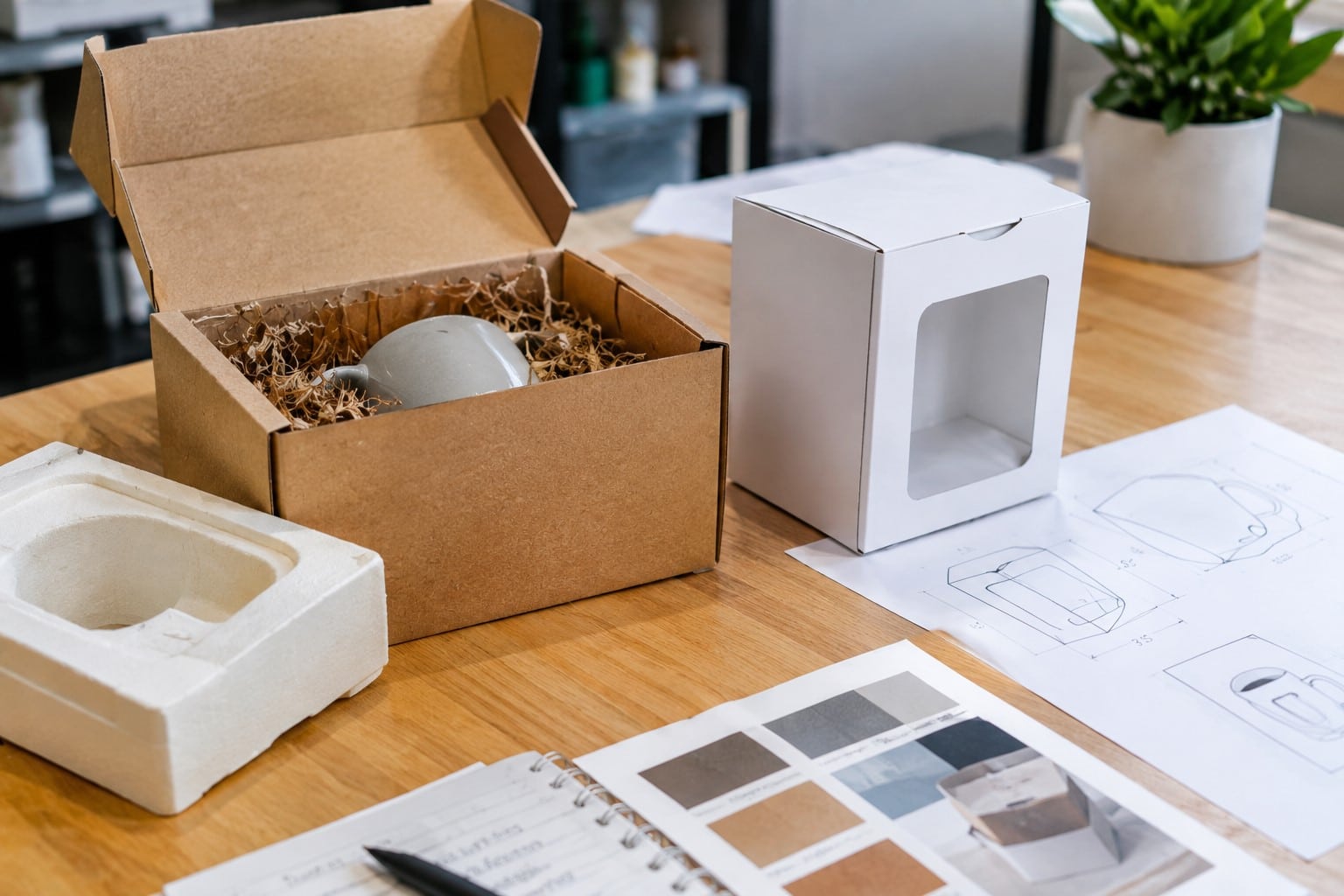
A packaging prototype is a preliminary model of the package. The goal of creating such a sample is to check the feasibility of the concept, structure, sizes, and functionality of the future packaging.
The prototype can be helpful, for instance, for checking whether:
- The product fits in the box
- The box folds and closes well
- Inserts fix the product inside
- The sizes are suitable
- The package structure is proper for production
It should be noted that prototypes can be made without materials or methods of production that are planned for further use in mass production. For example, it is a digitally printed, hand-cut, and hand-assembled prototype.
A prototype should be considered as the means of development and the answer to the question “Does this packaging idea work?”
What Is a Custom Packaging Sample?
A custom packaging sample is the physical model of your packaging created for testing purposes prior to the large-scale production order.
According to the project, the sample can be blank, printed, or created according to the final manufacturing specification, and can be tested for the following features of packaging, such as structure, materials, printing, finishing, product fit, and look and feel.
For example, a custom packaging sample can help you check.
- Paper or board quality
- Printing and position of the artwork
- Color reproduction
- Foil stamping or embossing
- Lamination or coating
- Product fit
- Closure systems
- Final look
Thus, a sample is really helpful when the brand decides to approve packaging for mass production.
Difference Between Custom Packaging Sample and Prototype
It is easy to tell the difference by considering purpose and whether or not the piece is ready for production.
A prototype is developed mainly to try and test an idea. A custom packaging sample, on the other hand, can be used to check how the finished packaging will look and work before approving it for production.
It is important to note that terminology may vary from one packaging manufacturer to another. While some suppliers refer to an early physical sample as “prototype”, others distinguish between prototypes, printed samples, and pre-production samples.
The best thing would be to consult your packaging supplier about what will actually be done with the sample and what materials, printing, finishing, and manufacturing process it will involve.
Prototype
- Design and structure development
- Temporary or alternative materials
- Testing size and functionality
- Developed early in the process
Custom Packaging Sample
- Physical representation for evaluation
- Actual materials and branding
- Printing, finishing, and product fit
- Used before mass production approval
Pre-Production Sample
- Closely aligns with the production process planning
- Utilizes approved materials, printing, and finishing methods whenever possible
- Gives the last reference for large-scale manufacturing
- Becomes the approved production standard
Why Packaging Samples Are Needed
Ordering custom packaging in large volumes without seeing it in person will only add additional risks to your business. A computer simulation provides some visual idea of what your package will look like, but it will never provide the complete picture of how the materials feel, how the package works, and how the colors and finishes will look on the actual substrates.
Physical custom packaging samples allow brands to see all the potential problems when changes can still be made. Issues can range from wrong dimensions to poor product fit, unsuitable materials, printing differences, weak closures, or undesired finishing effects.
That is why packaging sampling is not just a part of the approval process – it is the quality control procedure.
Which One Is Required by Your Business?
Depending on your stage in packaging development, the right solution will vary.
If your packaging design is under development, then using a packaging prototype or structural dummy is recommended to check the dimensions, folding, product fitting, and functionality. You will be able to test all of these before spending money on the printing process.
If the design of the packaging is completed, making a request for a custom packaging sample will give you an extra step of verification before placing a bulk order. This step is especially useful when you have a project that includes special finishes, complex structures, customized inserts, or high-volume production.
Conclusion
Knowing the difference between a custom packaging sample and a prototype allows choosing the right validation stage for your packaging project. The prototype is useful to develop and check your packaging concept, while the custom packaging sample is useful to see how the proposed package looks. In case of a more complex project and a requirement for higher production certainty, a pre-production sample will help.
Need professional custom packaging samples, prototypes, and packaging solutions? Check out Yiruixing Packaging to talk about your packaging needs and development requirements.
Turn your packaging concept into a physical sample with confidence – contact Yiruixing Packaging to discuss your packaging needs today.
FAQs
Is a packaging prototype similar to a custom packaging sample?
Not necessarily. There is some degree of overlap between these two terms, but usually, a prototype means a development version, while a custom packaging sample is created for verification purposes at a later stage of design development. Make sure the specifications of the sample correspond with what you ordered.
Why would I need a physical packaging sample?
Because it allows you to examine all the aspects of the sample before going into mass production, including dimensions, fit of the product inside the packaging, material quality, printing, finishing, and performance of the structure.
Could a prototype be made of different materials than the final packaging?
Of course, especially when it is a development prototype. Different materials that are readily available or under development can be used for a prototype. A production-based sample needs to be more reflective of what will ultimately be used in making the package.
Is a digital mock-up of the packaging sufficient?
While a digital mock-up is helpful in evaluating the design, artwork, proportions, and overall visual aesthetic, it is unable to provide an evaluation of how the package fits the product, how the material feels, or how well it performs structurally. It also does not evaluate how the finish looks on the actual substrate.
What should I look for in a packaging sample?
Look at all aspects of the package, including dimensions, product fit, thickness of the material, proper folding, placement of artwork and logos, colors, closure mechanism, and overall construction. Also, confirm that the sample shows the agreed details for production approval.