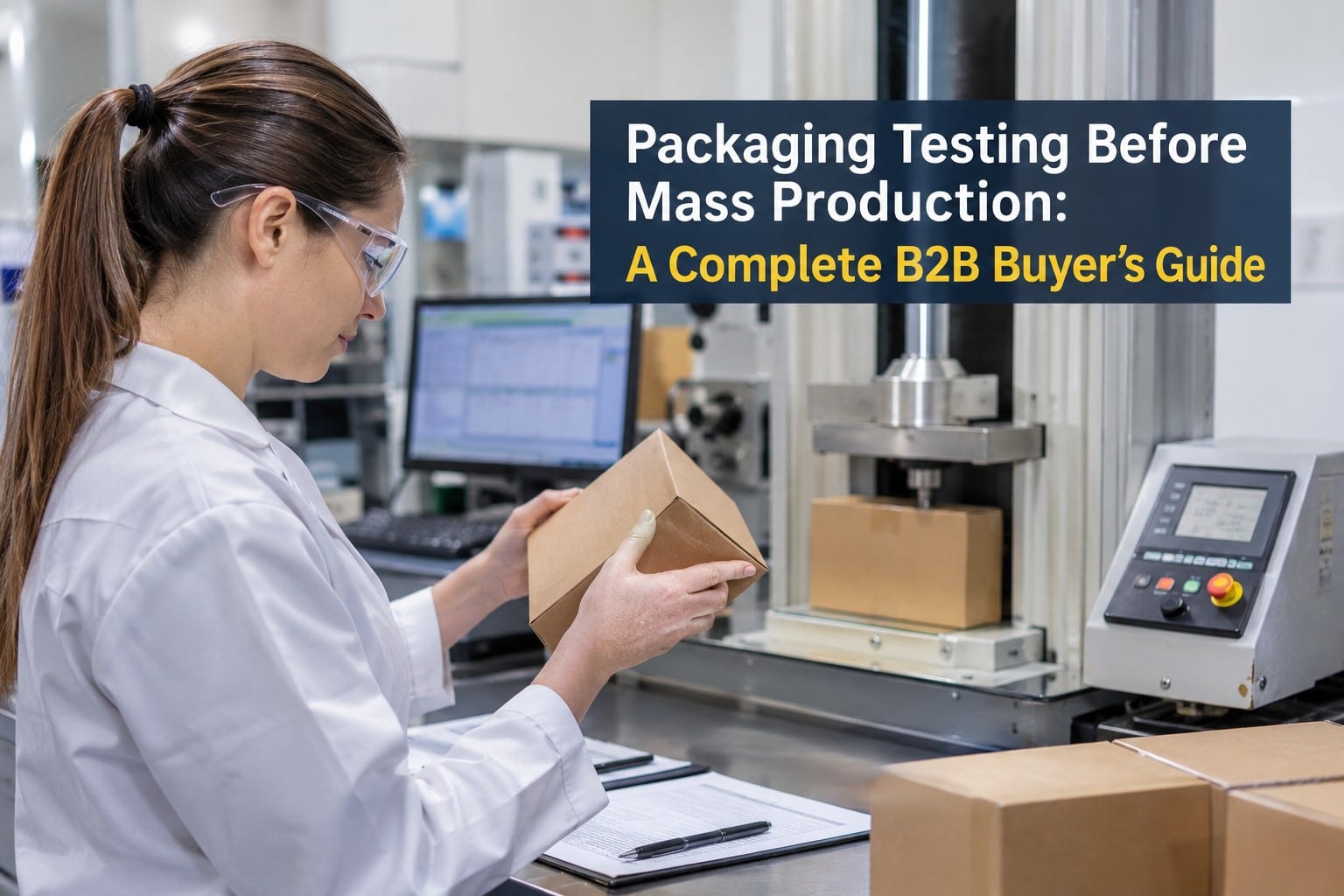
Packaging Testing Before Mass Production: A Complete B2B Buyer’s Guide – In the packaging industry, any mistake in the production process can result in huge expenses for your business. Sample packaging cartons may fall down during transportation; printed color shades may not coincide with the design approved earlier, protective inserts cannot guarantee the safety of product inside the packaging box. All of these can cause damage to goods, customer complaints, delays in delivery, and unnecessary business losses.
That is why Packaging Testing Before Mass Production: A Complete B2B Buyer’s Guide is a valuable subject to study for manufacturers, wholesalers, importers, and procurement professionals. Before making your decision about approval of the large-scale production process, you should conduct an analysis of the quality, durability, material behavior, and functionality of packaging. Let’s discuss what B2B buyers should consider before giving the green light to the mass production process.
Why Is Packaging Testing Important Before Mass Production?
Testing of packaging before the mass production process allows identifying any possible problems in the design and manufacturing process of packaging units.
The tiniest flaw in terms of material thickness, printing, size, or strength can have implications for the whole order. Addressing such defects at the stage of sampling is usually simpler and more cost-effective than addressing them in the course of production.
Some important advantages are the following:
- Reduces risks of production: Shows possible flaws prior to mass production.
- Ensures quality assurance: This is because the package will always meet the specifications set out by the samples provided.
- Provides product safety: Minimizes the dangers associated with damage to the product during storage, transport, and handling.
- Saves money: Saves on the cost of materials due to reduction in returns and expensive rework.
- Improves the reputation of the brand: Makes sure that the packaging looks professional.
For B2B customers who are responsible for large orders, testing is not a waste of money. It is a valuable quality assurance measure.
7 Essential Packaging Tests to Be Conducted Before Mass Production
Not every packaging product requires the same testing procedure. Still, the tests below will help most B2B packaging projects.
1. Testing of Material Quality
Start with testing the materials that are used for the production of packaging. Consider their thickness, weight, strength, texture, and quality.
An example includes custom-made boxes, for which the company should verify the paperboard quality, and in the case of corrugated boxes, the company should be concerned about board strength and composition.
2. Compression and Strength Test
Packaging has to survive the pressure force that is exerted on it when stacking and shipping.
A compression test verifies whether the box can resist the pressure force without getting deformed or collapsing. This applies to all boxes that are considered heavy-duty and shipping boxes.
3. Drop Test
Your product is likely to fall when loading, unloading, and shipping.
A drop test will help you determine whether your package can protect the contents from any impact. It is important for fragile products, electronic items, and glass products.
4. Vibration Test
Distance travel causes your product to be in constant motion.
It will help you to identify any loose parts, damaging closures, shifting of products, and poor internal cushioning.
5. Printing and Color Consistency Test
Since packaging is an expression of your brand, printing quality is important.
Review the placement of the logo, colors, legibility of the text, finishing, and alignment. Companies need to compare production samples against artwork and physical samples.
6. Dimension and Fit Testing
Improper size may lead to problems during packaging, storing, and transporting processes.
Measure the package and check for any problems related to the fit and movement of the item.
7. Functional and Closing Tests
Check zippers, magnetic closing mechanisms, handles, hinges, lids, glue, and other functional components.
For example, an expensive rigid gift box should be easy to open and should stay closed and maintain its shape during handling.
Testing protocols such as ISTA and ASTM are frequently used in the industry to assess packaging performance. It is necessary to choose the right procedure depending on the product and real conditions of its distribution.
How B2B Buyers Can Create a Pre-Production Testing Process for Packaging
It helps simplify the packaging purchasing process.
Step 1: Share all packaging specifications. Include product dimensions, preferred materials, artwork, quantities, finishing requirements, and applications.
Step 2: Order a physical sample. Instruct your packaging supplier to create a sample reflecting the proposed specifications for production.
Step 3: Examine quality and functionality. Pay attention to the material quality, dimensions, printing, durability, and usability.
Step 4: Perform necessary testing. Choose the correct tests, taking into account the shipping conditions, product sensitivity, and buyers’ requirements.
Step 5: Approve the sample. Record the approved specifications, such as the material grade, dimensions, color, and finish.
Step 6: Control the quality during the production process. Ensure that your manufacturer adheres to the approved specifications in mass production.
Please note, sample testing does not have to end at sample approval. Ensuring the consistency of the sample and final bulk order is just as crucial.
Mistakes That B2B Buyers Should Avoid in Packaging Development
Even experienced procurement teams can sometimes miss important aspects when developing packaging.
Here are some common mistakes to avoid:
- Approving the production process based on product photos only.
- Overlooking material specifications and thickness.
- Omitting transportation tests.
- Failing to examine printing and color consistency.
- Not documenting the approved samples.
- Picking suppliers by quotations only.
- Neglecting quality control when manufacturing in bulk.
The perfect partner would be happy to discuss the specifications, send samples, address any worries, and adhere to the proper quality control procedure.
Conclusion
Testing the packaging prior to manufacturing in bulk is one of the most efficient means by which the buyer can make an informed decision, maintain the quality of the product, and foster better supplier relations. A well-tested package inspires confidence down the entire supply chain.
For all those who need customized packaging solutions supported by manufacturing quality control, we highly recommend that you contact Yiruixing Packaging. This company provides customized packaging solutions, sample testing, raw materials inspection, and quality control during mass production. Get in touch with its specialists to discuss packaging options.
FAQs
Why should packaging be tested before mass production?
This process detects any problems with material, structure, design, and print of packaging before producing large quantities. Packaging testing allows reducing production risks, improving protection of products, and keeping their quality stable.
What packaging tests are the most important for B2B buyers?
Tests include material quality inspection, compression testing, drop testing, vibration testing, printing inspection, dimensional inspection, and functional testing. The specific tests to conduct depend on the package and mode of transportation.
How many samples should be tested before mass production?
The number of samples depends on the package design, testing criteria, risk, and confidence level. In case of visual inspection, only one sample will be enough, but performance tests may require multiple samples.
What is the ISTA and ASTM packaging test?
It refers to procedures used by these organizations to evaluate the performance of packages and packaging materials. ISTA offers procedures that mimic various distribution environments, and ASTM deals with such issues as vibration, compression, and drop tests.
When should B2B buyers authorize mass production?
Mass production should start once the buyer has inspected the final sample, verified the material and design specifications, conducted any needed quality tests, and agreed on the quality control standards during production.