
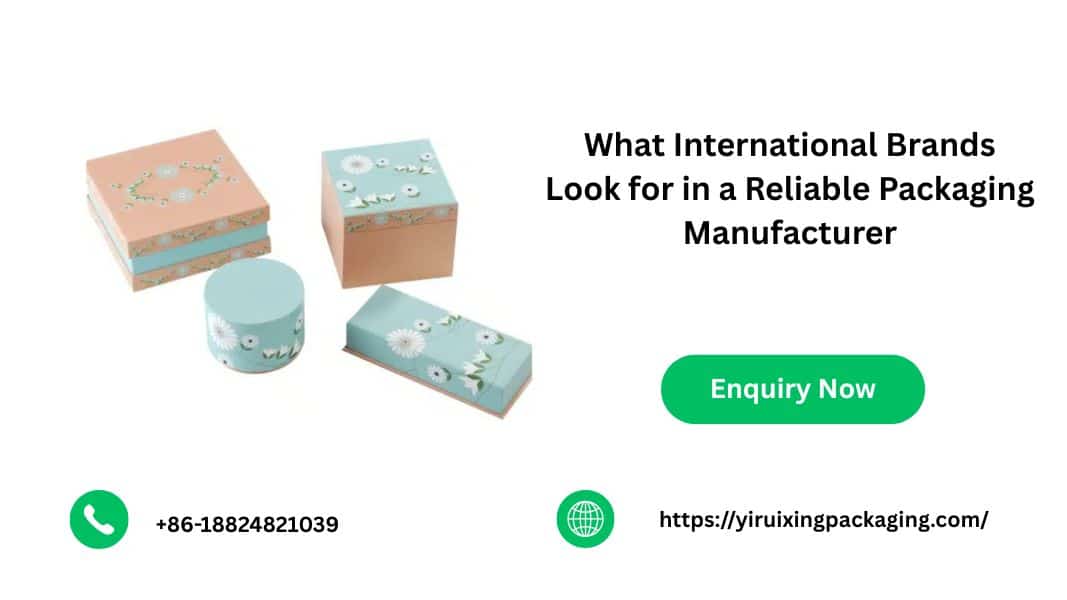
What International Brands Look for in a Reliable Packaging Manufacturer – Nowadays, in the fiercely competitive global market, packaging plays a role beyond just being a protective cover – it is a major aspect of a brand’s identity and customer experience. When global companies are selecting suppliers, they thoroughly evaluate What International Brands Look for in a Reliable Packaging Manufacturer in order to guarantee quality, consistency, and dependability over time. Besides certifications, sustainability practices, etc., choosing a packaging partner involves several other deciding factors.
1. International Certifications and Compliance
Holding internationally recognized certificates is usually the very first condition that global brands put on packaging manufacturers. These certificates prove that a company uses standardized methods and complies with international safety and quality standards. Typical certificates are:
- ISO 9001 – Quality management systems
- ISO 14001 – Environmental management systems
- BRCGS Packaging Materials – Requirements for packings used in the food and retail supply chains
- FSC (Forest Stewardship Council) – Responsible paper and wood fiber sourcing
Through these certificates, the supplier indicates that they have operating procedures, quality assurance, and product tracking systems that meet the criteria for inspection by customers and regulatory authorities.
International brands consider certified suppliers as a way to minimize risks related to compliance failures, delivery hold-ups, and product quality inconsistencies.
“Certifications will not ensure a supplier’s flawless performance, but they prove that the supplier runs organized systems and has well-documented procedures.”
2. Strong Quality Control and Testing Processes
Established packaging manufacturers know very well that a rigorous quality control (QC) system is the most efficient way to ascertain that a product is always up to the mark. Expert suppliers, especially those associated with leading brands, conduct various tests on materials, perform structural inspections, and make a final check before the products are shipped. Packaging quality tests that are commonly carried out are:
- Edge Crush Test (ECT) for corrugated strength
- Bursting strength tests for durability
- Adhesion and delamination tests
- Printing and color accuracy checks
All of these tests ensure that the packaging not only protects the products during transportation but also helps in maintaining the brand’s visual identity. Along with that, suppliers usually offer samples or prototypes before the bulk production to enable brands to check material quality and design accuracy.
In the absence of continuous quality control, packaging faults may eventually result in product damage, customer dissatisfaction, and brand image loss.
3. Production Capacity and Scalability
Global brands function on such a large scale that it is imperative that their packaging partners can produce a large amount of product without losing quality. Trustworthy manufacturers usually have:
- Large-scale manufacturing facilities
- Automated production lines
- Skilled technical teams
- Efficient supply chain management
Furthermore, a packaging supplier should be willing and able to increase production to accommodate seasonal demand or product launch surges. A consistent supply helps brands to avoid leading to distribution or e-commerce fulfillment delays.
4. Design Expertise and Technical Capabilities
Packaging nowadays not only supports function but also marketing. Therefore, international brands lean towards manufacturers who are capable of delivering top-notch design and engineering. A reliable packaging partner should be able to develop:
- Custom structural design
- Precision inserts for product protection
- Advanced printing and finishing techniques
- Sustainable material alternatives
In the case of cosmetics, electronics, and luxury items, packaging is a determining factor of customer perception and a brand’s market position. Vendors with innovative design departments can help brands produce packaging that is visually appealing both at open store shelves and on online platforms.
5. Sustainability and Responsible Sourcing
Sustainability has evolved into an essential factor for international brands. Consumers continuously look for packaging that is environmentally friendly, and many large international companies have set their targets along the lines of environmental conservation. That is why brands usually consider the criteria of packaging manufacturers to include:
- Use of recyclable or biodegradable materials
- FSC-certified paper sourcing
- Low-impact inks and coatings
- Waste reduction practices in production
Having environmental certifications such as ISO 14001 and FSC, brands can prove that their packaging supply chain is in line with responsible resource management.
Conventionally, choosing sustainable packaging partners also brings brand recognition and conformity with global environmental rules.
6. Communication and Long-Term Partnership
Finally, international brands also put a lot of value on good communication and openness from their packaging factories. Suppliers who can be trusted will always keep in touch regarding production schedules, raising of technical problems, and quality standards. Some of the major elements of a fruitful partnership are:
- Fast response times
- Clear project management processes
- Transparent pricing and lead times
- Proactive problem solving
One reliable packaging partner is not simply a seller but a long-term co-worker that assists brands in innovating and elevating their packaging solutions over time.
Conclusion
It is a very crucial matter to choose wisely the right packaging partner for international brands that depend on consistent quality, compliance, and reliable supply chains that are reliable. Among the major contributors determining whether a certain manufacturer is capable of meeting international standards or not are factors like certifications, quality control systems, production capacity, sustainable practices, and communication.
Companies like Yiruixing Packaging are dedicated to offering first-class, highly adaptable packaging solutions that can be tailored specifically to international standards. Apart from being a manufacturer and having both skills and experience in quality control, they are able to guide brands toward finding the right packaging products to suit their global markets.
FAQs
Why do international brands require packaging certifications?
Certificates authenticate that the factory has been operating as per industrial requirements of quality, safety, and environment. This way, it is possible to minimize supply chain risks as well as to have consistent packaging performance.
What is the top certification that packaging manufacturers should aim for?
Most people agree that ISO 9001 is the certificate to start with. It not only confirms that a company has a quality management system in a formal structure, but also that it is a quite reliable one.
How can brands be sure about packaging quality before going for mass production?
It’s industry standard for brands to require prototypes or sample production and testing them through a variety of ways, such as durability tests, drop tests, and checking print quality.
Why sustainability matters in packaging manufacturing?
Eco-friendly packaging is extremely beneficial to brands on many levels, such as reducing their carbon footprint, fulfilling governmental laws, and targeting and winning over environmentally aware consumers.
What is the significance of packaging design in manufacturing?
The packaging design has an impact on both protecting the product and the way the brand is perceived. Excellent packaging design greatly improves the opening experience and makes the brand more recognizable.