
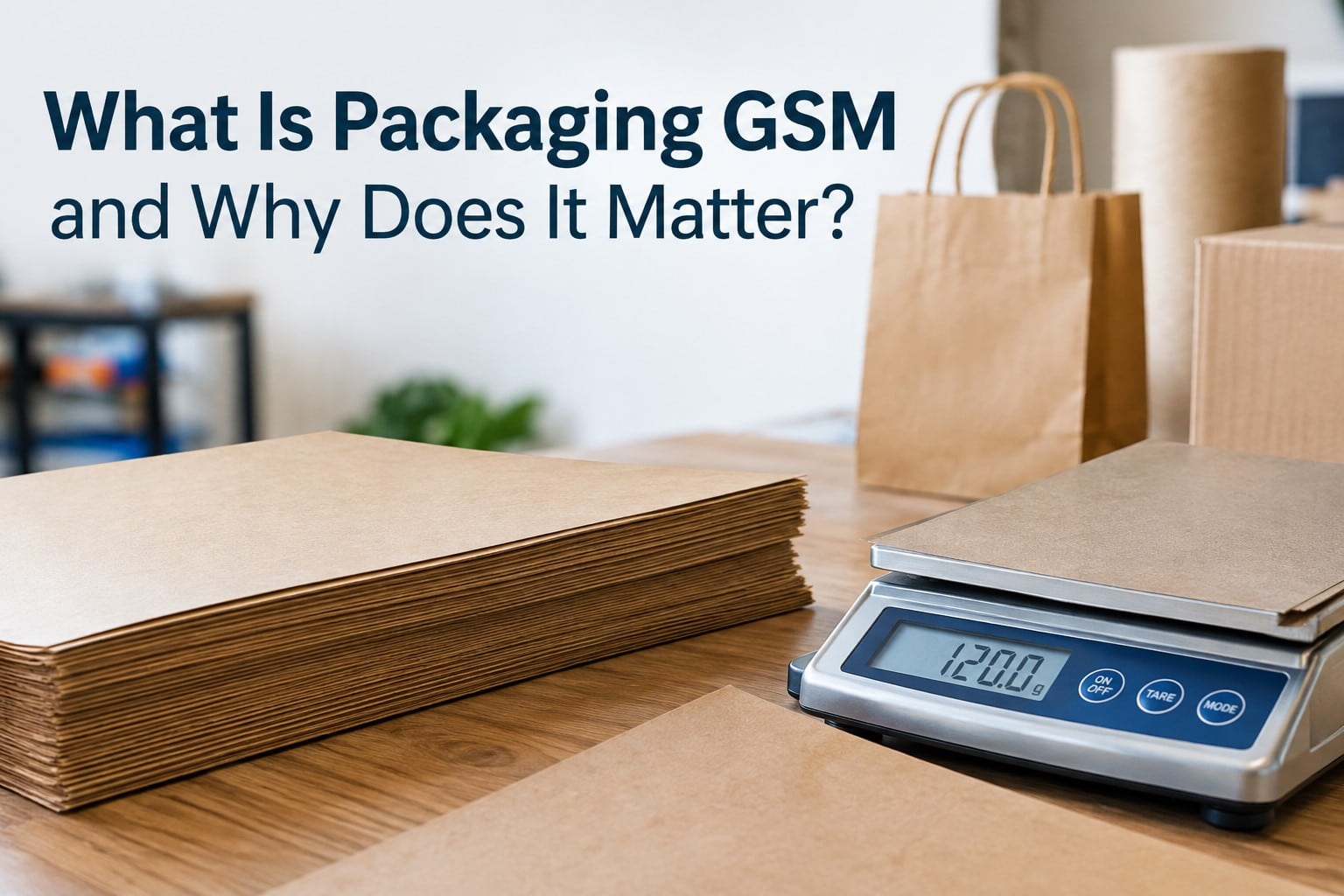
What Is Packaging GSM and Why Does It Matter? – When selecting the right packaging materials, you will encounter terms like GSM, paper weight, board thickness, and packaging strength. But what are these all about? How does knowing the meaning of such terms help in ensuring the quality of your packages?
GSM in packaging means “grams per square meter.” It is the measure of the weight of one square meter of paper or paperboard. A board rated 330 GSM weighs 330 grams per square meter. GSM is commonly used in measuring paper, cardboard, folding carton board, and other packaging materials.
Knowing the meaning of packaging GSM and its importance will aid business owners in choosing the right packaging that strikes a good balance between appearance, cost, and protection of products.
What is the Meaning of GSM in Packaging?
GSM, or grams per square meter, is the measure of the mass of paper or board in a certain area. Simply put, the higher the GSM, the heavier the mass per square meter.
Specifications of typical GSM papers can differ drastically from one product to another and from one packaging design to another. Thin packaging will involve GSM papers that have lower GSM, while thicker packaging will be made of high-GSM papers.
However, one should note that GSM is not always directly associated with thickness. Two boards with the same GSM can have varying thickness since they can have different density, fiber content, coatings, and manufacturing processes.
Therefore, when choosing packaging material, one should consider several factors along with GSM, including board grade, caliper, structure, coating, and intended application.
Caliper in packaging is the actual thickness of the paper or paperboard, and it is expressed in millimeters or microns. Although GSM stands for the weight of the material per square meter, caliper is the thickness of the material. Both these measurements can be taken into account when choosing packaging materials since two boards with the same GSM will differ in caliper.
Why Does GSM of Packaging Matter?
The reason why packaging GSM matters is that the material specification affects several factors in the final packaging.
1. Packaging Resistance and Durability
Choosing appropriate GSM will allow keeping the packaging shape while handling, storing, and shipping it. If the material used is too light for the packaging, it will have flexibility problems, which will prevent it from providing proper protection.
High GSM materials are usually heavier than low GSM ones, but packaging resistance will also depend on other characteristics like board grade, packaging construction, and size.
2. Protection of Product
Often, the first barrier of protection between your product and the outer world is the package itself. The proper board specifications will help ensure that your products are protected from bending, crushing, scuffing, and regular handling.
Choosing the suitable packaging board GSM is specifically important for fragile, premium, or heavier products.
3. Premium Look and Feel
Packaging speaks about the quality of the product without the customer seeing it. It can add the feeling of sturdiness through the use of heavier board that is often preferred when making luxury packaging, cosmetics, gifts, perfumes, and other premium retail packaging.
Therefore, GSM is not just a physical property of the packaging but also an aspect of its tactile qualities.
4. Printing and Finishing
The material you choose also influences how well the package holds up during printing and finishing processes. It can feature CMYK or Pantone printing, matte or gloss lamination, embossing, debossing, hot stamping, spot UV, and many other finishing effects.
Proper board specification will make sure that the packaging can handle all that you need it to.
5. Cost and Shipping Weight
The use of a higher GSM material would require more material and would possibly make the packaging heavier.
However, using a lower GSM to cut costs would mean making packaging that wouldn’t perform as well as expected. The goal is to choose the proper GSM based on what the product needs, rather than always opting for the highest GSM.
How Do You Know Which GSM to Use in Packaging?
There isn’t a single GSM for all packaging needs. To determine the right GSM, consider the following aspects:
- Weight and size of the product
- Needed level of protection
- Structure and design of the box
- Conditions for shipping and storage
- Print needs
- Surfaces finish
- Desired look and stiffness
- Production quantity and budget
Also, the common specifications for GSM can be dependent on the type of packaging involved. For instance:
- Folding cartons: 250 – 350 GSM SBS / Kraft board
- Chipboard for rigid box: 1200 GSM / 1400 GSM (2.5 mm / 3mm thick)
- Mailer boxes: GSM is less common; ECT and flute type (B-flute, E-flute) are usually used to define specifications.
For example, folding cartons will require a different kind of board compared to rigid gift boxes or corrugated shipping boxes. Similarly, cosmetics will require different packaging compared to foods, electronics, or industrial products.
A packaging manufacturer can help you determine the right GSM material after assessing your product, box sizes, structural design, printing, and surface finishing needs.
GSM vs. Thickness: What Is the Difference?
Caliper and GSM represent two different aspects of packaging materials. Caliper is the measurement of the actual thickness of the packaging material, whereas GSM represents the weight of the paper or board in grams per square meter. However, a high GSM does not always result in a correspondingly high caliper due to density, among other factors.
To get a precise packaging specification, one needs to include GSM + material grade + thickness/caliper + box structure and not just use GSM.
Why GSM Needs to Be Specified When Ordering Custom Boxes
When making a custom packaging box order, general descriptions like “strong cardboard” or “premium material” might result in inconsistencies.
A good packaging specification should include quantifiable parameters such as the material, GSM or thickness, size, printing process, surface texture, and structural specifications.
That way, it will be easier for manufacturers and buyers to keep consistency from sample to production.
Types of Packaging Boards and GSM
Various types of packaging boards are chosen based on the product to be packaged, the desired appearance of the packaging, its structural qualities, and the requirements of printing and finishing operations. SBS (solid bleached sulfate) and Kraft board are most frequently used for folding cartons. A chipboard is usually used for rigid boxes. Flute size and ECT are factors used to choose corrugated mailer boxes.
SBS board is another name for the solid bleached sulfate board and comes in various GSM specifications depending on the packaging application. For folding cartons, the GSM range can be approximately 250-350; however, it depends on the product to be packaged, the box size, its construction, printing, and finishing requirements.
There are also differences between kraft board and SBS board in their appearance, composition, and applications. Kraft board is usually considered to be a board of natural brown color, which is often used where a more natural appearance is needed, while SBS board is characterized by a bright white color that allows quality printing and premium packaging.
Conclusion
When you have knowledge about GSM packaging, you will understand its importance in selecting the right packaging material. GSM packaging is used to determine the weight of paper or board; however, you need to take thickness, grade, construction, and usage of packaging materials into consideration. If you want to get retail cartons, cosmetic packaging, gift boxes, mailer boxes, or other types of custom packaging solutions, choosing the right material specification will definitely help you reach the balance between protection, presentation, and budget.
To order professionally manufactured custom packaging solutions, you can visit the website of Yiruixing Packaging. The company’s specialists will help you choose material specifications, printing, structure, and finishing to turn your packaging requirements into ready-to-produce solutions. Please contact Yiruixing Packaging now to discuss your custom packaging requirements.
FAQs
What is GSM packaging?
The abbreviation GSM means grams per square meter and determines the weight of paper or paperboard within one square meter area. It is often used when specifying packaging materials such as carton board, paper bags, folding cartons, and other paper-based packaging.
Is higher GSM the same as stronger packaging?
Not always. Generally speaking, higher GSM equals higher weight per square meter of material and higher substance, but the strength of the packaging depends on many other things such as board grade, thickness, composition of fibers, box construction and design.
Which GSM is used in packaging boxes?
This depends on the nature of the box – its size, weight, purpose, and so on. Packing materials can vary from thin paper sheets to thick boards for premium cartons and packaging. In other words, don’t choose the GSM by its number alone – consider the whole packaging specification.
Is GSM equal to the thickness of the packaging?
Not at all. While GSM equals the weight per square meter, the thickness is measured in millimeters. The two materials can have the same GSM but different thickness due to their different composition and density.
Which GSM should I use for my custom packaging?
You should take into account the weight of your products, dimensions and design of the box, printing, required protection, shipping conditions, appearance, and budget. Your packaging manufacturer will be able to offer you suitable specifications for your packaging and give you a physical sample.
What do you mean by caliper in packaging?
Caliper means the thickness of the paper and/or paperboard and is generally expressed in millimetres or microns. In contrast to GSM, which is an expression of the weight of the paper or paperboard, calipers denote the true thickness of the packaging board.
What is the SBS board (Solid Bleached Sulfate) GSM range?
The GSM of the solid bleached sulfate, or SBS board, varies based on the packaging requirement and can range from 250–350 GSM for folding boxes. However, the appropriate GSM will depend on the product type, box size, construction, printing, finish, and protection.
How is a kraft board different from an SBS board?
The differences between kraft board and SBS board lie in terms of color, construction, and application. Kraft boards tend to have a brownish color tone, whereas SBS boards have a bright white tone that serves as an ideal basis for superior print and packaging design. The selection largely depends on the product being packaged, design, print, finishing, and performance.
Will higher GSM enhance foil stamping/embossing effect?
Higher GSM can provide the board with greater strength and density and thus make it a better option for some foil stamping and embossing projects. However, GSM in itself cannot determine the quality of the finished result. Thickness, grade, quality of the surface, composition, coating, depth of the embossing, foil, and production parameters may affect the result.