
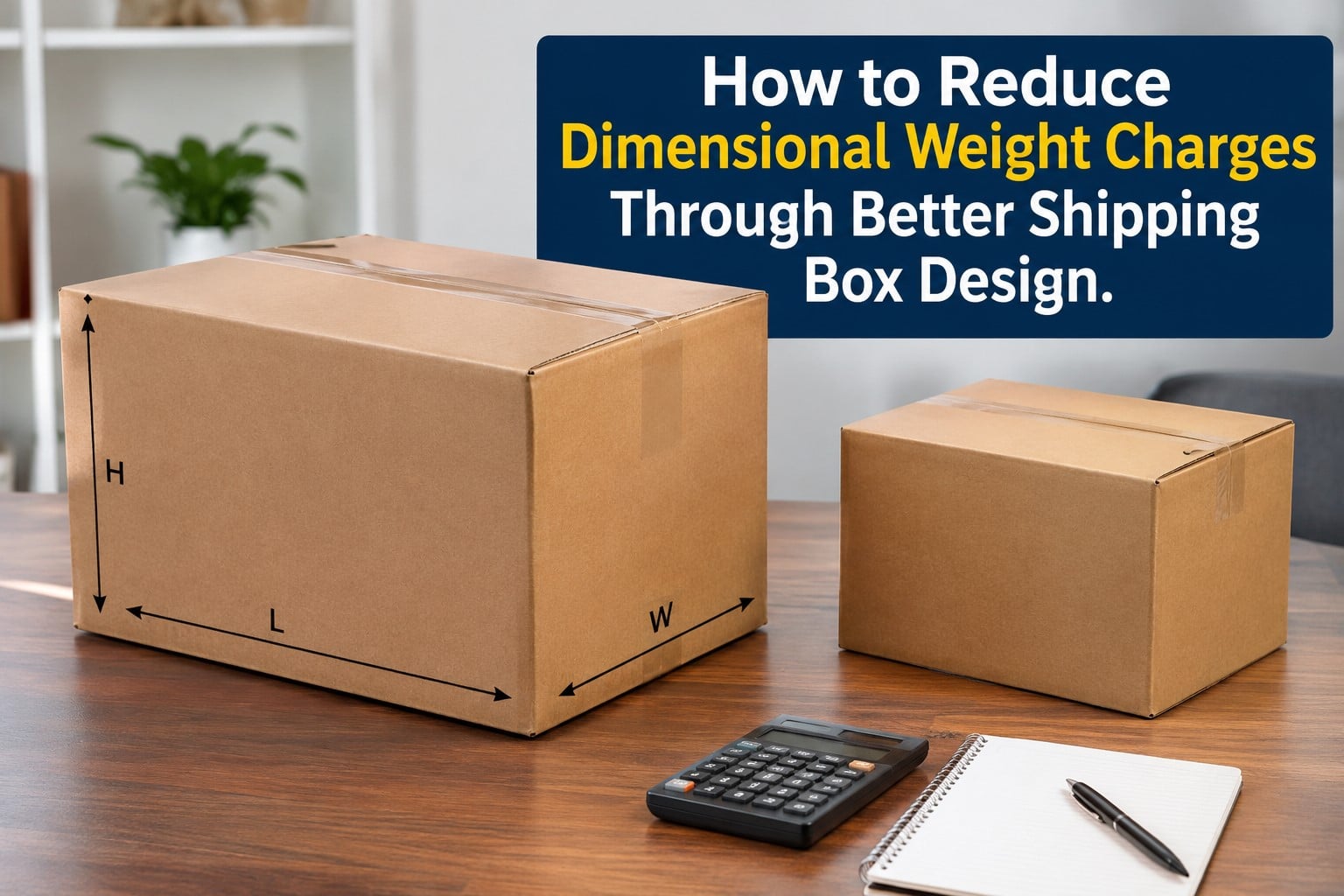
Shipping costs can very easily become significant portions of profit margins, especially since packages might take up more room than justified by their weight. While many companies concentrate on decreasing the product’s weight in order to save, there is one more aspect that must be taken into account: the shape of the shipping box.
It is quite common that carriers use DIM weight (or dimensional weight) in the calculation of the shipping costs. It is based on the size of the package (length, width, height), and not on its physical weight. It means that shipping light products in too-big boxes might result in much higher shipping costs than expected.
And the good news is that with a proper packaging strategy, you can significantly reduce your shipping costs without any risk to the safety of your product. So let’s talk about how to reduce dimensional weight costs with proper shipping box design.
What Is Dimensional Weight in Shipping?
Dimensional weight is a billing technique used by shipping companies. It is aimed at calculating the amount of space the package takes up during the shipping process. The shipment of a light and big parcel can cost more compared to a smaller and heavier one due to the increased size.
Carriers usually calculate dimensional weight by the following formula:
Dimensional Weight = (Length × Width × Height) ÷ DIM Divisor
Measurements should be done in inches in case an inch divisor is used. Depending on the specific carrier and service used, the appropriate divisor, rounding, and billable-weight calculations may differ.
For instance, a large box with lightweight goods inside may have the dimensional weight higher than the actual weight of the cargo. If the dimensional weight is higher than the actual weight, the carrier may charge accordingly.
7 Methods for Minimizing Dimensional Weight Fees through Improved Packaging
1. Using the Right Size of Shipping Box
One of the easiest methods of reducing your shipping costs is not to use too big a shipping box. An oversized package that is way bigger than its contents will increase the dimensional weight and will require additional packaging.
Instead, select a proper box in which your product fits with the appropriate padding space. Do not fill your box with too much space, but do not sacrifice product safety for the sake of reducing package dimensions.
2. Create Custom Shipping Boxes for Your Products
Standard boxes offer convenience, but they might not be a good choice for all products. Customized boxes help companies save space by providing a better fit for their products.
For instance, a company selling electronics and delivering them through shipping boxes needs customized boxes based on the dimensions of its products to use an extra-large shipping box for each order.
The use of customized shipping boxes will enable companies to save on space, make sure that there is no need for excess packaging material, and have a standardized packing procedure.
3. Choose Space-Saving Shipping Box Shapes
Shipping box sizes impact dimensional weight; therefore, companies have to choose the most appropriate shapes of boxes.
Rectangular boxes are common because they stack easily and make efficient use of shipping space, yet the dimensions will vary depending on the product to be transported.
Make sure that you do not go for unnecessarily tall or wide boxes since the most appropriate box shape should fit your product.
4. Avoid Too Much Packaging Material
Protective materials are necessary to prevent any damage, yet too much cushioning leads to increased package size.
Think about employing adequately sized inserts, corrugated partitions, paper cushioning, or molded protective elements. All these solutions will ensure the security of your items without extra void filling.
The idea is not to exclude protection. It is just about striking the balance between safety and optimal dimensional weight.
5. Take into Account Lightweight Corrugated Packages
Package material also plays an important role since it contributes to the total weight of shipment. The choice of lightweight corrugated packages helps to reduce the weight of the actual package and at the same time provides reliable protection.
Just choose the right corrugated board grade, flute type, and structure, taking into account the specific product weight, its fragility, stacking properties, and transportation conditions.
6. Optimize Package Sizes
In case a company ships several products, it usually has too many box sizes. This leads to additional expenses and inefficiency.
Design your packaging size portfolio. Find out some optimized carton sizes that will fit most often shipped products. Categorize products based on dimensions and choose packaging methods that use the least unused space.
Shipping boxes of standard size would be easier to manage in a warehouse, pack effectively, and would help companies control the costs of dimensional shipping.
7. Evaluate and Measure Packaging Effectiveness
Do not make assumptions that a smaller box always equals good packaging. Evaluate your packaging before making any changes to all shipments.
Measure external dimensions, dimensional weight, compare shipping costs using different types of boxes, and test them with drop, vibration, and compression tests if necessary to ensure the protection of products.
Monitor important metrics like cost of packaging per order, rate of damages, DIM weight, and shipping costs. It will show you how you can improve packaging.
Why Better Box Design Is Important for E-Commerce Businesses
For e-commerce businesses, choosing proper packaging is not only about shipping costs but also about customer satisfaction, warehouse performance, product protection, and environmental performance.
Saving space in packaging could help e-commerce businesses:
- Decrease costs of dimensional weight and shipping.
- Minimize the amount of packaging material used.
- Increase the efficiency of storage and delivery logistics.
- Avoid unnecessary transportation and possible shipping damage.
- Ensure a more professional and consistent opening process of packaging.
To summarize, good packaging design is about more than reducing the size of the package. Good packaging design is about packaging that provides product protection with the most economical use of material and transportation space.
Conclusion
In order to lower the dimensional weight cost, the right packaging choice matters a lot. Choosing the correct-sized box, custom corrugated packaging, and other small design changes can actually have quite an impact on shipping expenses.
If you are in need of professional packaging solutions, check out Yiruixing Packaging. Find a variety of custom packaging products and solutions that are suitable for product protection, box sizing, and shipping efficiency. Contact the team to find out more about packaging solutions.
FAQs
How can I lower dimensional weight cost?
Use appropriate box sizing, custom packaging for each item, avoid unnecessary void fill, and correct the carton dimensions. Check actual weight vs. dimensional weight in any case.
Does a smaller shipping box mean lower cost?
This does not have to be the case. A smaller box may reduce dimensional weight, although the end shipping cost will depend on other factors such as weight, pricing rules of the carriers used, nature of the package, and services offered. The safety of the products should always take precedence.
Which type of packing material is the best choice when it comes to minimizing shipping costs?
Lightweight corrugated cardboard is one of the commonly used materials since it provides the required combination of durability, protection, and weight considerations. This all depends on the requirements of the products being shipped.
How do custom packaging shipping boxes help in minimizing the DIM weight?
Custom packaging shipping boxes are created in accordance with the product dimensions, thus ensuring that unnecessary space is eliminated. This way, you can minimize the dimensions of the outer packaging and even the cushioning.
How often should businesses audit their packaging solutions?
Changes in packaging should be undertaken when there is a change in the size of products, volumes for shipment, pricing guidelines, or damages incurred. Periodic packaging evaluations could reveal other potential savings.