Packaging compliance will continue to play an important role in an increasingly competitive supplement and nutraceutical industry. As such, the packaging regulations in effect by 2025 will be even more stringent and enforced on a global basis than those currently in place today. For companies just starting with their first product, or established brands looking to expand their operations around the world, compliance with all requirements will be critical to maintain consumer trust and to prevent fines from being imposed.
If you are working with a Packaging Company in China and sourcing Containers, Pouches, and Boxes from Packaging Manufacturers in China, it will be critical for you to remain informed of the most current Global Packaging Requirements as of 2025. This Guide has been developed to enable you an easy way to follow the requirements imposed on you beginning in 2025. This Guide also contains a detailed Packaging Compliance Checklist that you can follow to ensure compliance with the requirements imposed by the Global Packaging Industry that are required by World Manufacturers/Electronic Manufacturers after 2025.
Why Is Packaging Compliance So Important?
More consumers today are becoming more aware of what goes into their bodies, and therefore are checking labels, learning about ingredients in detail, and noticing the quality of the packaging they are purchasing products in. Increased scrutiny has resulted in Regulatory Agencies throughout the World becoming stricter and employing greater scrutiny against those companies that do not provide the necessary details on their labels and who provide inaccurate information regarding the products being sold.
Being Noncompliant could result in:
- Recalls of your Products
- Delays in Customs Processing for your imported Goods
- Loss of Inventory
- Fines Imposed Upon You and Bans from Selling in Certain Markets
- Reduction of your Company’s Reputation
Working with an experienced Packaging Manufacturer in China will help you mitigate the risks of being noncompliant with the Global Packaging Requirements, especially when these manufacturers provide you with the appropriate documentation (FDA, ISO, and SGS) in addition to their professional expertise.
Updates on Packaging Regulations for 2025
As we begin this list, let’s look at the most notable changes to supplement and nutraceutical packaging regulation:
- More Noticeable and Clearer Labeling & Placement
Regulators now want to require companies to have clearer and more easily seen places where the allergen alerts, dosage directions, and safety warnings will go. The terms “clinically tested” and “supports immunity” will require scientific proof to back them up.
- Increased Sustainability Requirements
Retailers and e-commerce platforms are asking brands to switch to recyclable, biodegradable, and mono-material packaging. There may be cases where certain mixed-materials packaging will no longer be allowed.
- Tamper-Evident Packaging is Now a Requirement
Tamper-evident packaging is no longer optional; it’s a requirement for safety. Tamper-evident packaging includes induction seals, tear bands, and shrink bands.
- Increased Scrutiny on Import and Export Documentation
If you are sourcing from a packaging company in China, you’ll need proper certification to export to an international market, which includes FDA compliance, REACH, RoHS, heavy-metal testing, and quality certificates for manufacturing.
- The Increase of QR Codes and Digital Transparency
More countries are implementing digital traceability of products via QR codes that link to ingredient specifications, testing reports, and authenticity information.
As you can see from the checklist below, these regulations will create lots of paperwork for you to keep your product compliant.
Checklist for Complete Packaging Compliance for 2025
This step-by-step checklist will help ensure that your supplement or nutraceutical product meets all compliance requirements.
1. Confirm All Packaging Materials Are Safe & Certified
Make sure that your packaging materials (bottles, jars, sachets, boxes) are all safe for food contact and supplement-grade. Here are some things to look for:
- Look for BPA-Free plastics
- Check whether they meet FDA food-contact requirements
- Check out the EU Certifications for Food Grade and REACH
- Look for testing reports from SGS or Intertek
Most reliable packaging manufacturers in China will automatically provide this documentation.
2. Check That Your Labels Meet All Requirements
A label mistake is one of the most common reasons that companies get into trouble with regulatory agencies. Your label should include:
- Product Name
- Supplement Facts Panel
- Ingredients List
- Allergen Disclosure
- Net quantity of contents
- Manufacturer/distributor address
- Warning statements
- Directions for use
All of your claims on your label must be accurate and substantiated by documentation.
3. Include Required Warning Statements
Supplements must state clearly what warnings apply regarding safety for:
- Pregnant or nursing people
- Potential for interaction with medicines
- Possible allergens
- Risks associated with children using the products
If any ingredient could potentially cause an interaction, you should note that in your caution statement.
4. Use Tamper-Resistant Packaging
Tamper-resistant packaging is now an important requirement for consumer safety. Effective forms of tamper-resistant packaging include:
- Heat induction foil seals
- Shrink-wrapped seals
- Breakable or tear-off tops
- Tamper-evident packaging notches
A Chinese packaging manufacturer will be able to facilitate the integration of these elements into your custom-made packaging.
5. Include Expiration Dates and Batch Codes
Every product must contain a permanent and readable
- Batch/lot number
- The manufacturing date (as may be required per region)
- Expiration/best by date.
This gives retailers and regulators a way to track production runs, as well as a way to manage recalls if necessary.
6. Eco-Packaging is a Must
The following are examples of more environmentally responsible eco-packaging options:
- Recycling PET /polyethylene (HDPE) (polyethylene terephthalate),
- Biodegradable or compostable pouches
- FSC-certified paper packaging (e.g., boxes)
- Single-material (mono-material) packaging structures.
Many packaging manufacturers in China now have expertise in providing environmentally friendly solutions, including the supporting documentation required for each option.
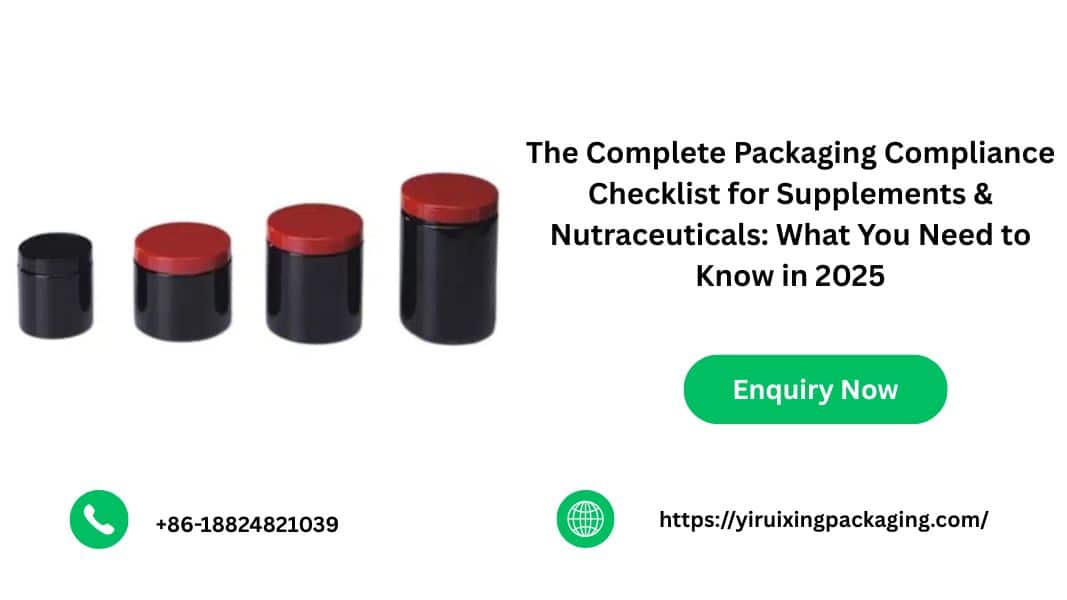
7. Protect Your Supplements From Humidity, UV rays, and Heat
Packaging for dietary supplements should have the ability to protect the dietary supplement from degradation due to exposure to the above three factors. There are several ways to accomplish this:
- UV-blocking bottles,
- Moisture barrier-type pouches,
- Airtight seals
- Desiccants inside bottles
As well as testing laboratory certifications such as MVTR (Moisture Vapor Testing Rate of Moisture), “Moisture Vapor Transmission Test”, and laboratory seal-strength tests.
8. Each Country Will Have Market-Specific Requirements
Each market will have unique regulations and requirements on all nutrition-related product packaging. For example:
- The USA will require FDA lettering design and DSHEA Compliance
- The EU will have EFSA recommendations for dietary supplement packaging and require multiple language labels
- Canada’s requirements include Natural Product Number (NPN) Certification
- Australia’s requirement is TGA certification
- The Middle Eastern region has Halal certification for select markets.
Please confirm the packaging you will use for each region.
9. Confirm that All Import and Export Documentation Is Completed
If you are importing or exporting products that are packaged outside the USA, it is important to verify that you have the appropriate supporting documentation (when imported) and that the following documents are current before shipment.
These steps will improve your success rate with customs and ensure that your packaging product is safe for your customers.
10. Test Your Packaging With Your Actual Product
Before producing packaging for mass consumption, it is crucial that you test the usability and durability of the packaging before production, which includes the following:
- Seal integrity
- Drop resistance
- Shelf-life stability
- Heat and humidity tolerance
- Shipping durability
An established supplier can aid in the evaluation of packaging by performing necessary assessments or supplying you with the relevant data.
Final Thoughts
For brands seeking to maintain compliant nutraceutical and supplement packaging in 2025, creating a straightforward checklist for packaging requirements and collaborating with responsible suppliers is critical. As an established source for quality customizable nutraceutical package solutions, Yiruixing Packaging should be considered. Contact Yiruixing Packaging and make sourcing safe, beautiful, straightforward, and stress-free.
FAQs
What is the leading packaging requirement for supplements in 2025?
Label accuracy and tamper-evidence are the top concerns for regulators; without them, your product will likely fail an inspection.
Can I get compliant packaging from a packaging company in China?
Yes, many packaging manufacturers in China produce globally compliant packaging, and they can provide FDA, SGS, REACH, and ISO documentation.
Does every supplement have to contain child-resistant packaging?
Not all supplements have to have child-resistant packaging; however, products with a higher risk will be more attractive to retailers with child-resistant closures.
Will QR Codes be required in 2025?
QR codes will not be mandated everywhere in 2025; however, it will be very beneficial to use QR codes as they provide a very high level of traceability and transparency to the consumer market.
How often should a company update its supplement packaging?
For most nutraceutical brand companies, the life of a valid regulatory-compliant supplement packaging is typically 1-2 years, and as needed, based on changing market consumer trends.