
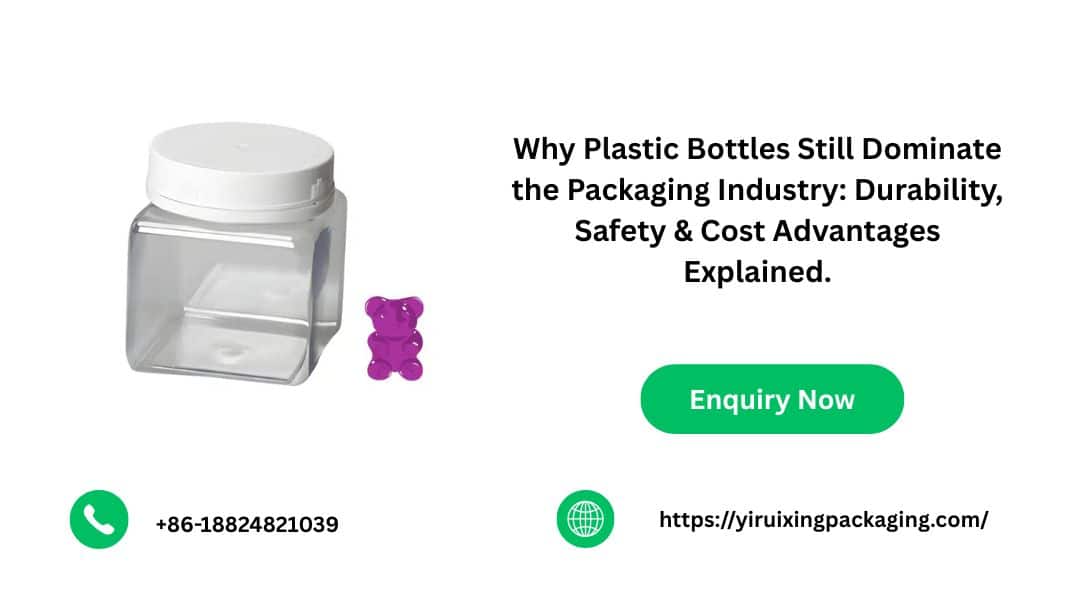
When you go to your local grocery or drug store, you can see right away how common it is to find plastic bottles. From the plastic pill bottles to drink containers to plastic candy jars with lids, there’s no shortage of plastic items on store shelves, even though there’s a growing demand for environmentally friendly products.
The big question – if we’re all trying to be more eco-friendly these days, why are plastic bottles still such a hot commodity?
The answer isn’t a simple one. Plastic continues to be the number one choice of packaging material because of several key factors: durability, safety, affordability, consumer convenience, and technological advancement. Let’s take a look at each of these factors individually in an easy-to-understand way to explain why plastic packaging is still so popular.
1. The Durability of Plastic Bottles
The durability of plastic bottles is likely the most important reason for their continued popularity. Compared to glass, which can break easily when dropped, plastic bottles are strong and durable.
- They can also safely withstand shipping without breaking.
- They can also survive accidental drops.
- They can withstand changes in pressure caused by being stored under pressure or changing temperatures, as well as due to rough treatment during the shopping process.
If you have ever experienced a broken glass bottle in your grocery bag, you probably know how upset you were! The reliability of plastic bottles, especially for products like prescription drugs, is an extremely important quality. Plastic pill bottles which are extremely resilient against any stressors during transport (such as vibration from shipping) and even when thrown into a purse.
“Durability is an essential aspect of the safe and efficient distribution of products.”
Many industries cannot put themselves at risk of having fragile packaging alternatives available to them.
2. Plastic Packaging Provides Outstanding Safety for Consumers.
Plastic packaging is strong and protects consumers. For example, the food and beverage and pharmaceutical industries heavily rely on plastic packaging to protect their products.
Reasons Why Many Industries Consider Plastic Packaging Safe for Various Applications:
- Plastic packaging is lightweight, which reduces the chance of injury due to dropping.
- Plastics approved by the FDA can resist contamination.
- Plastics create an airtight seal to preserve a product’s freshness.
- Packaging helps to prevent spoilage, leakage, and exposure to bacterial growth on the products.
Many products, such as candy, pills, supplements, spices, and snacks, need to be in a tightly sealed container. This is why you can find plastic candy jars with lids in most stores, candy shops, and pantries. Moisture is kept out; the freshness is kept in; little hands stay out of trouble.
3. It Is the Most Economical Option (By Far)
When it comes down to economics, plastic packaging is significantly less expensive to manufacture, ship, and store compared to most types of alternative packaging. Some examples:
- The cost of plastic is typically 30-50% less than the cost of manufacturing glass.
- Plastic’s Lightweight Nature Eases Manufacturing and Distribution
- It is much lighter and can be shipped in much smaller quantities, thereby reducing fuel consumption.
- Plastic is extremely easy to manufacture on a large scale.
For companies that deliver millions of units of products, the savings from a lower production price are not just a minor benefit; they result in very large savings. Additionally, lower production costs keep consumer prices relatively less expensive as well. For example, if glass bottles were to replace plastic containers for pill packaging, the costs associated with the packaging for medications would increase significantly.
4. The Lightweight Nature of Plastic: Making Life Easier for Everyone
One thing that people never think about when it comes to packaging is the weight. Plastic has a density that is as much as 20 times less than that of glass. The weight of the packaging impacts:
- Shipping costs
- Carbon emissions
- Consumer convenience
- Storage logistics
For instance, if you are shipping 1,000 glass jars of candy, rather than 1,000 plastic jars with lids, the difference in total weight may be hundreds of pounds, which would in turn increase shipping costs and ultimately raise the price that consumers would pay for that candy.
5. Plastic’s Versatility and Customization: The Quality of Plastic
Plastic is flexible. This means that it can be moulded into virtually any shape, size, or style, whether it’s a child-resistant cap for a plastic pill bottle, or a large-mouthed place for bulk candy. Because of this, plastic can be produced in accordance with the needs of the product and will allow brands to be innovative with respect to their designs.
Handles created with plastic allow you to easily add logos and provide a means to put tamper-evident seals. In addition, when you’re talking retail, both the look and the function are essential. The most effective answer is to use plastic at an economical rate.
6. Recycling Changes the Game
Although the concern about plastic’s environmental consequences is valid, and may even be growing for customers, the industry is evolving rapidly. Improvements made recently include using more rPET, or recycled plastic; better recycling streams; using bio-based plastic made from renewable resources; and more reclaim facilities being built globally.
Some sources estimate that PET plastic bottles have a recycling rate above 30% in the United States, which continues to improve along with the infrastructure. Although we have a long way to go, we are making progress, and as the consumer demand increases, companies are implementing greener practices.
7. Consumer Convenience Wins Every Time
While the industry heavily influences the presence of plastic, consumers also have a large influence. Many people are inclined toward plastic because:
- It’s lighter to carry
- It’s not likely to break
- It can be resealed easily
- It’s safe for children
- It’s easy to store
For example, have you ever attempted to store bulk snacks in glass containers? They are heavier, more breakable, and noisier than plastic containers with lids. A canister made of plastic offers simple everyday storage, and customers enjoy their convenience.
When plastic is the preferred choice for millions of people, companies take notice.
Conclusion
There is a clear reason that plastic bottles dominate the packaging marketplace: they are cost-effective, safe, very durable, and extremely versatile. Plastic can protect your prescription through its pill bottles and make storage attractive with its candy jars with lids; thus, plastic continues to be very practical for the ever-changing environment we live in today. While there are still sustainability challenges to overcome, many innovations in recycling and the production of plastics are putting the industry on the right path to sustainable product solutions. For now, plastic is the most efficient way to package products, and businesses and consumers rely on plastic for their everyday packaging needs.
FAQs
Why don’t we use glass containers for more products if they can be recycled like plastic?
While glass containers can be recycled, they are significantly heavier and more delicate than plastic containers, as well as more expensive to manufacture and ship. Plastic offers both a lower cost and greater durability, which are the main reasons it is eventually going to become the material of choice in the mass production of packaging.
Are plastic bottles suitable for use with food and medicine?
Yes. Food-grade and pharmaceutical-grade plastics undergo rigorous testing before they can be classified as such. The Federal Drug Administration (FDA) imposes specific requirements for the manufacture of plastic pill containers; these requirements demonstrate that pill containers will not contaminate stored medications and are safe for use with medication.
Is plastic damaging to the environment?
Plastic can be damaging to the environment when it is improperly disposed of; however, many developments in plastic recycling, bioplastics, and waste management are improving the way plastics are used and disposed of.
Why do candy manufacturers favor plastic packaging?
Plastic candy jars with lids are light, sturdy, resealable, affordable, and help preserve freshness.
Will plastic ever be fully replaced in packaging?
Not in the near future. New alternatives are being developed, but plastic’s unique mix of low cost, strength, safety, and convenience keeps it vital.